
Figure 1 Dorothea Lange, Migrant Mother, 1936.
The Great Depression is often explained through charts, data, and economic models, but it was first experienced as a human crisis. Images like Dorothea Lange’s Migrant Mother remind readers that behind falling prices and contracting credit were families facing uncertainty, displacement, and prolonged unemployment. The economic collapse was not abstract. It was lived daily, often with little sense of when or whether recovery would come.
That human dimension matters when evaluating competing explanations for the Depression. While the stock market crash captured national attention, it did not by itself produce a decade-long economic collapse. What transformed a downturn into a systemic crisis was the contraction of the money supply, the spread of deflation, and the inability of policymakers to stabilize credit and demand. Just as importantly, recovery did not occur because markets naturally corrected themselves. Rather, it unfolded only when monetary conditions shifted. This interpretation does not resolve every historiographical debate, but it offers the most consistent explanation for the Depression’s depth, duration, and eventual recovery.
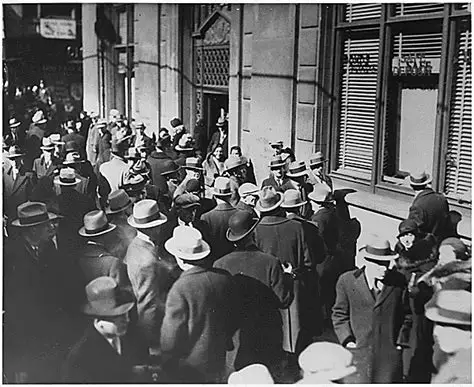
Figure 2 Depositors gather outside a band during the Great Depression
This analysis uses both primary and secondary sources. The primary evidence comes from monetary trends and policy actions: bank failures, changes in the money supply, the gold program, and shifts in interest rates. The secondary sources provide interpretation and context. Christina Romer offers the strongest empirical case for monetary recovery. Michael Bernstein places the Depression within a broader historiographical debate over short-term shocks, policy failure, and long-term structural weakness. Robert Samuelson highlights the importance of institutional constraints, especially the gold standard. Fred Foldvary’s Austrian interpretation is useful as a contrast because it attributes the crisis to earlier credit expansion rather than to the collapse in demand after 1929. Read together, these sources make it possible to test one theory against competing explanations rather than simply summarize them.
A monetary reading begins with a straightforward claim: the Depression became catastrophic when money and credit collapsed. The stock market crash weakened confidence, but it cannot fully explain the sustained contraction in production, employment, and prices. As banks failed, the money supply contracted, setting off a deflationary spiral. Falling prices increased the real burden of debt, making it more difficult for households and businesses to spend, invest, or repay existing obligations. In this environment, price adjustment did not stabilize the economy; it intensified contraction. Samuelson’s discussion of Irving Fisher’s debt-deflation framework is particularly helpful here, illustrating how defaults, declining asset values, and falling prices reinforced one another. Bernstein similarly argues that explanations focused solely on 1929 fail to explain why the crisis deepened over time.
This monetary interpretation also explains why the Depression spread and persisted internationally. The gold standard limited the ability of governments and central banks to expand the money supply and stabilize domestic economies. Samuelson argues that the gold standard acted as a straitjacket because countries feared that aggressive monetary action would threaten convertibility and trigger further instability. In practice, that meant governments often defended gold rather than employment or recovery. The result was not simply policy error in an ordinary sense. It was institutional rigidity built into the preexisting monetary order. That point matters because it helps explain why the Depression lasted so long even after the initial shock had passed.
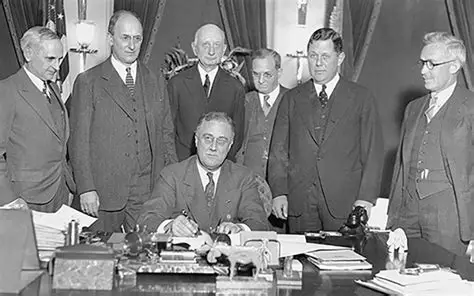
Figure 3 Franklin D. Roosevelt Signs the Gold Reserve Act, 1934
The Austrian theory offers a serious counterargument, but it is less persuasive on the question of why the Depression remained so severe for so long. Foldvary argues that the real problem began in the 1920s, when artificially low interest rates and credit expansion encouraged overinvestment, particularly in real estate and long-duration capital. In that reading, the Depression was the correction of earlier “malinvestment.” That interpretation has explanatory value, particularly in understanding why a credit-fueled boom can become unstable. Still, it is less effective in explaining the magnitude of the collapse after 1929 and the weakness of recovery absent policy change. If the downturn had merely been a market correction, one would expect adjustment to have worked faster and more fully than it did. Instead, unemployment remained extraordinarily high and output stayed depressed for years. The monetary framework better accounts for that prolonged failure.
Christina Romer’s analysis is especially important because it addresses the other half of the question: what ended the Depression? Her answer is clear. Recovery before 1942 was driven largely by monetary expansion, not by fiscal policy and not by spontaneous self-correction. Gold inflows, devaluation, and changes in monetary conditions expanded the money stock, lowered real interest rates, and stimulated investment and purchases of durable goods. In Romer’s estimates, without those monetary changes, the economy would have remained far more depressed for much longer. That argument matters because it shifts the focus from the common claim that World War II alone ended the Depression. Wartime mobilization certainly completed the recovery, but the economic turn had already begun once monetary conditions changed in the mid-1930s.
This is where the monetary theory proves strongest. It explains both the collapse and the recovery through the same mechanism. When money contracted, the economy spiraled downward. When money expanded, output recovered. That does not mean fiscal policy was irrelevant in every respect, nor does it mean structural problems did not exist. Bernstein is right to remind readers that the Depression was also a broader historical problem connected to changes in capitalism and economic thought. But if the question is which single theory best explains the crisis and its eventual demise, the monetary interpretation remains the most convincing because it connects cause, persistence, and recovery in one coherent framework.
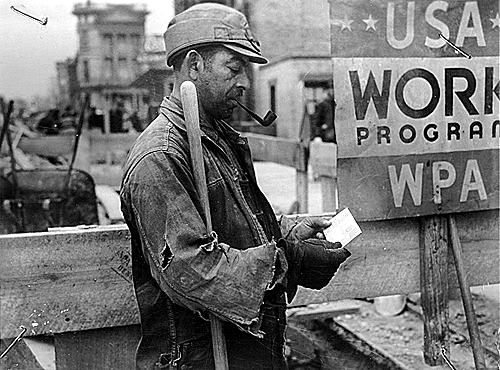
Figure 4 WPA worker receiving paycheck during the New Deal
The Great Depression was not simply the result of the stock market crash, nor was it just the delayed correction of excesses from the 1920s. It became a prolonged catastrophe because monetary collapse and deflation undermined the functioning of the broader economy. It persisted because institutional constraints, particularly the gold standard, limited policy responses. And it ended not through spontaneous adjustment, but through a shift in monetary conditions that restored spending and investment. Other interpretations contribute to our understanding, but the monetary framework provides the most complete explanation of the Depression’s full trajectory from collapse to recovery.
Bibliography
Bernstein, Michael A. “The Great Depression as Historical Problem.” OAH Magazine of History 16, no. 1 (2001): 3–10.
Foldvary, Fred E. “The Austrian Theory of the Business Cycle.” American Journal of Economics and Sociology 74, no. 2 (2015): 278–297.
Lange, Dorothea. Migrant Mother. Photograph. Nipomo, California, 1936. Library of Congress, Prints and Photographs Division.
Romer, Christina D. “What Ended the Great Depression?” The Journal of Economic History 52, no. 4 (1992): 757–784.
Samuelson, Robert J. “Revisiting the Great Depression.” Wilson Quarterly 36, no. 1 (2012): 36–43.
Franklin D. Roosevelt Presidential Library and Museum. “Bank Run During the Great Depression.” Photograph. ca. 1930s.
Franklin D. Roosevelt Presidential Library and Museum. “President Roosevelt Signs the Gold Reserve Act.” Photograph. January 30, 1934.
U.S. National Archives. “WPA Worker Receiving Paycheck.” Photograph. 1930s.

